A bald man wearing sunglasses, a brown sweater, and green pants, holding a microphone and speaking. A guitar is standing on a stand beside him, against a black background.

a justice-focused movement dedicated to addressing wrongful incarceration, medical neglect in correctional facilities, and systemic failures within the criminal justice system.

About Jose “Jay” Rodriguez — and Why the Jay Act Exists

Who is “Jay” — and why the Jay Act exists

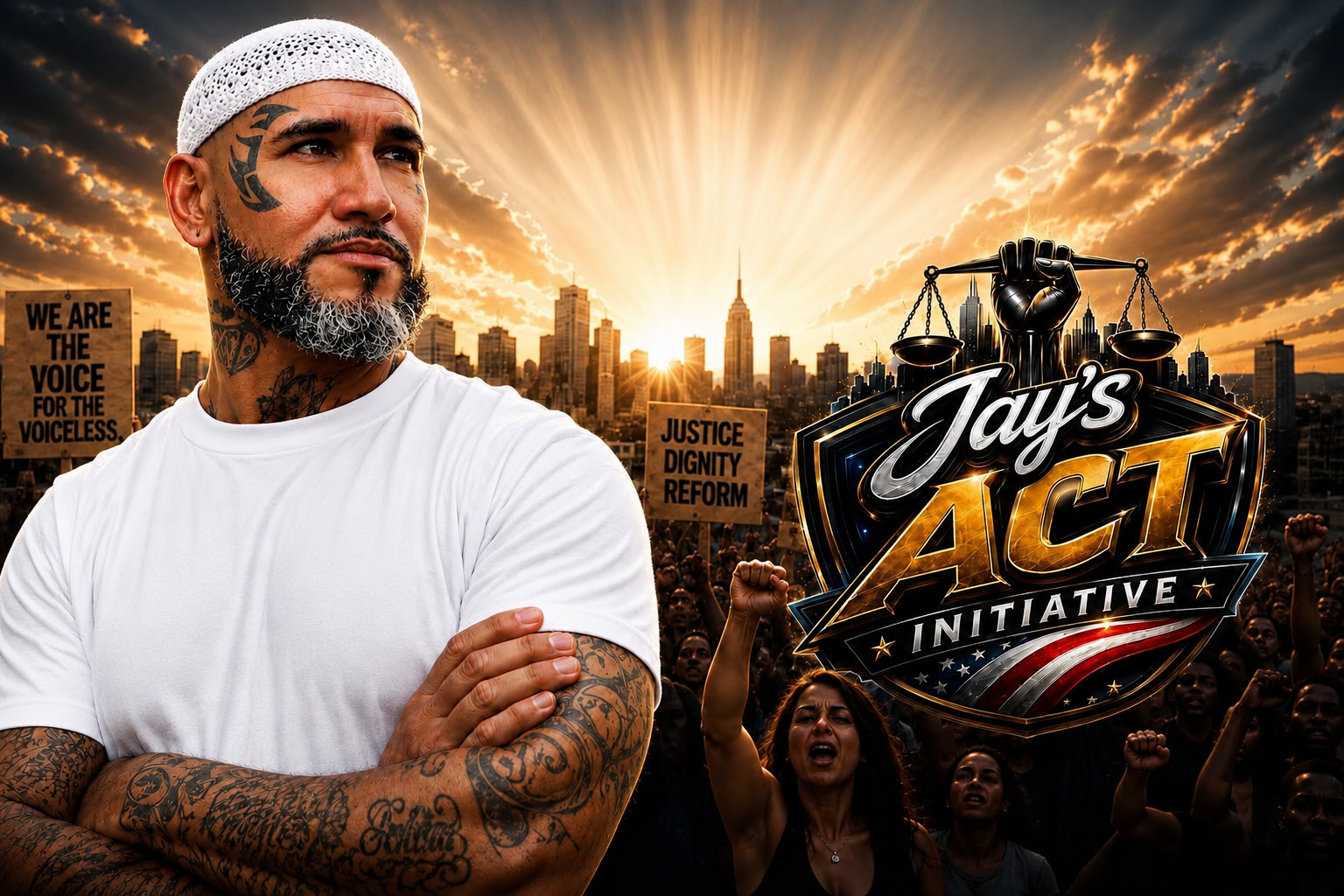
Jose “Jay” Rodriguez is my brother.

Before anything else—before the system, before the sentence, before the labels—he is family. He is someone who laughs, who guides others, who has mentored the people around him even while living in one of the most unforgiving environments imaginable.

For more than a decade, Jay has been incarcerated. And for years, I have watched from the outside as he has tried to survive not just confinement—but neglect.

He has asked for help.
He has followed the rules.
He has filed grievances.
He has been approved for care.

And still… he waits.

Today, Jay is battling squamous cell carcinoma—a cancer that began on his eyelid. What should have been addressed early, what should have been treated with urgency, was instead met with delay, inaction, and medical indifference.

Now, that cancer has progressed—attaching to his eyeball and possibly spreading to his neck.

This is what neglect looks like.
This is what delay costs.

There is a particular kind of pain that comes with knowing someone you love is suffering—and you cannot reach them. That their health is declining while requests go unanswered. That decisions about their care are delayed, ignored, or lost in a system that moves without urgency for the people inside it.

You start to realize something devastating:
This is not an exception. This is happening to people every single day.

And yet—even now, in the middle of his own fight—Jay continues to show up for others.

While battling cancer, he has continued to advocate, to guide, and to uplift the people around him. He has earned accomplishments, built respect, and used his voice to support others who feel forgotten. In a place designed to break people, he has chosen to build.

The Jay Act Advocacy & Legal Reform Initiative was born out of that realization—and out of refusal.

Refusal to accept that incarceration should mean neglect.
Refusal to stay silent while lives are treated as disposable.
Refusal to let my brother’s suffering—and the suffering of so many others—go unseen.

This is bigger than Jay. But it starts with him.

The Jay Act is a demand for humanity inside a system that too often forgets it. It is a call for timely, adequate medical care. For accountability when institutions fail. For transparency where there has been silence.

Most of all, it is a promise:

That we will not look away.
That we will not stop pushing.
That we will fight—for Jay, and for every person whose voice has been ignored behind prison walls.

Because no one deserves to suffer in silence.
And no system should be allowed to operate without answering for that suffering.

A man in graduation attire, wearing an academic cap and gown, standing behind a podium and speaking into a microphone.

Change Starts With Your Voice

〰️

Change Starts With Your Voice 〰️

“I feel so bad for other families cause I know first hand how it is to lose a loved one at the hands of the prison system. They just look at them as if they are a piece of garbage to be disregarded”

Toby Nunez

A VOICE BEYOND THE GRAVE - RAUL NUNEZ

Raul Nunez should still be alive.

Instead, his voice reaches us only through court filings, medical records, and the haunting timeline of a man who begged for help and was met with delay. While incarcerated at Green Haven Correctional Facility, Raul repeatedly reported severe pain, weight loss, and fainting—clear warning signs that something was terribly wrong. But his suffering was minimized, treated as routine, dismissed as manageable. It wasn’t.

By the time Raul was finally sent to an outside hospital in June 2019, the truth could no longer be ignored: he had advanced pancreatic cancer. A diagnosis that came not at the first cry for help—but at the brink of death. Shortly after, Raul was gone.

The court would later call this negligence, not deliberate indifference. But what is the difference to a man who died waiting? What is the legal distinction worth when measured against a human life?

And yet—Raul’s voice did not die with him.

It lives through his widow, Toby Nunez, who carries his story in a way no court record ever could. She keeps his ashes—because, as she says, she “couldn’t let him go.” Some of him remains with her, while some has been returned to his home country, the Dominican Republic. Even in death, he exists between places—between where he suffered, and where he belongs.

Through her, Raul still speaks.

He speaks in grief that refuses to be silenced. In love that refuses to be buried. In the quiet, devastating truth that his life might have been saved if someone had listened sooner.

Raul Nunez’s story is not just about one man. It is about a system where accountability fades behind prison walls, where suffering is too often unseen, and where voices are silenced long before death.

But Raul still speaks.

He speaks through the gaps in his care, through the delay that cost him his life, and through every unanswered question his death leaves behind. His story demands more than acknowledgment—it demands change.

Because justice should not end at incarceration. And medical care should never come too late.

If we listen closely, Raul’s voice is still here—beyond the grave—asking us one simple question:

Who will be next?

The jay act

Justice for Incarcerated Patients Act

Purpose

To establish mandatory medical treatment timelines for incarcerated individuals diagnosed with serious illnesses and to impose civil and administrative penalties on correctional medical providers and administrators who fail to provide timely care.

SECTION 1. SHORT TITLE

This Act may be cited as the “Jay Act.”

SECTION 2. FINDINGS

Congress finds that:

  1. The Eighth Amendment of the United States Constitution requires correctional institutions to provide adequate medical care to incarcerated individuals.

  2. Numerous federal court rulings have determined that deliberate indifference to serious medical needs constitutes cruel and unusual punishment.

  3. Delays in diagnosis and treatment of serious medical conditions—including cancer, autoimmune diseases, neurological disorders, and organ failure—can result in irreversible harm, disease progression, or death.

  4. Current correctional medical systems often lack clear timelines for treatment, resulting in prolonged delays and systemic neglect.

  5. Accountability mechanisms are necessary to ensure that incarcerated individuals receive timely medical care consistent with constitutional standards.

SECTION 3. MEDICAL EMERGENCY CLASSIFICATION

Serious Medical Condition under this Act includes:

  • Cancer or suspected cancer

  • Autoimmune disorders (including lupus)

  • Neurological conditions

  • Severe infections

  • Organ disease

  • Any condition that may significantly worsen without timely treatment.

SECTION 4. MANDATORY MEDICAL TIMELINES

All correctional facilities receiving federal funding must comply with the following:

Initial Medical Evaluation

Any incarcerated individual reporting symptoms of a serious medical condition must receive a physician evaluation within 72 hours.

Specialist Referral

If a physician determines that specialist care is required, the appointment must be scheduled within 14 days.

Diagnostic Testing

All medically necessary diagnostic tests (biopsy, imaging, bloodwork, etc.) must occur within 21 days of being ordered.

Cancer Treatment

Upon confirmation of a cancer diagnosis:

  • Oncology consultation must occur within 14 days

  • Treatment must begin within 30 days

SECTION 5. FAILURE TO COMPLY

If a correctional medical unit fails to meet the timelines established in this Act:

  1. The medical unit director and supervising officials may be held personally accountable through civil penalties.

  2. The correctional facility may face:

  • Loss of federal funding

  • Federal medical oversight

  • Mandatory external medical review

  1. Any delay that results in disease progression, permanent harm, or death shall be presumed to constitute medical neglect under federal law.

SECTION 6. PERSONAL LIABILITY

Medical administrators, contractors, and supervisory staff who knowingly delay or obstruct medical care may be subject to:

  • Federal civil penalties

  • Professional licensing review

  • Federal investigation by the Department of Justice Civil Rights Division.

SECTION 7. MEDICAL RECORD PRESERVATION

When a complaint or grievance related to medical neglect is filed:

  • All medical records must be preserved immediately.

  • Records must be provided to authorized family members or legal representatives within 7 business days.

Destruction, alteration, or concealment of medical records shall constitute a federal offense.

SECTION 8. INDEPENDENT MEDICAL REVIEW BOARD

The Department of Justice shall establish a Correctional Medical Review Board to:

  • Investigate allegations of medical neglect

  • Review deaths in custody

  • Audit correctional healthcare systems

  • Issue public reports.

SECTION 9. RIGHT TO EXTERNAL MEDICAL CARE

If a correctional facility cannot provide adequate treatment within the timelines required under this Act, the incarcerated individual must be transferred to an outside medical facility without delay.

SECTION 10. CIVIL ACTIONS

Families of incarcerated individuals harmed due to medical delays may bring expedited federal civil actions against responsible correctional agencies and medical contractors.

SECTION 11. IMPLEMENTATION

This Act shall take effect 180 days after enactment.

Core Principle of the Jay Act

No incarcerated person should suffer irreversible harm or death due to preventable medical delays.

Correctional medical units must operate under clear timelines, transparency, and accountability.


Meet the Founder- Stephanie harris

Stephanie Harris is more than a founder—she is a mother, an advocate, and a woman who refused to let pain go unanswered.

Born and raised in Brooklyn, New York, Stephanie is a proud mother of five whose life was forever changed by the injustices faced by her brother, Jose “Jay” Rodriguez. What began as a deeply personal fight for answers quickly evolved into something far greater—a movement fueled by love, resilience, and an unshakable demand for accountability.

Stephanie didn’t come from politics or policy. She came from real life—late nights, hard decisions, and the kind of strength that only comes from protecting your family at all costs. When systems failed her brother, she made a decision: she would not stay silent.

Out of that decision, The Jay’s Act Advocacy & Legal Reform Initiative was born.

Through her leadership, Stephanie has transformed grief into purpose—building a platform that not only seeks justice for her brother, but fights for countless others who have been overlooked, unheard, or mistreated. Her voice carries the urgency of lived experience, and her mission is clear: to expose systemic failures, demand reform, and ensure that no family has to suffer in silence.

Stephanie stands at the intersection of motherhood and movement—raising her children while raising awareness, pushing forward even when the weight is heavy. She represents every family still waiting for answers, every voice that has been ignored, and every life that deserves dignity.

Her work is not just advocacy—it is legacy.

Because for Stephanie Harris, this was never just about one story.

It’s about changing the system that allowed it to happen.

3% Cover the Fee

Make an impact

Create change

Empower Others

Make an impact ・ Create change ・ Empower Others ・

Make an impact

Create change

Empower Others

Make an impact ・ Create change ・ Empower Others ・

Contact Us

Interested in working together? Fill out some info and we will be in touch shortly. We can’t wait to hear from you!